Keplerian prism loupes
These give magnifications of 3.0 to 5.0 times, at the cost of depth of field. Because they are relatively heavy they are mostly worn as headband loupes.
Loupes allow a minimally invasive, tissue-preserving approach.
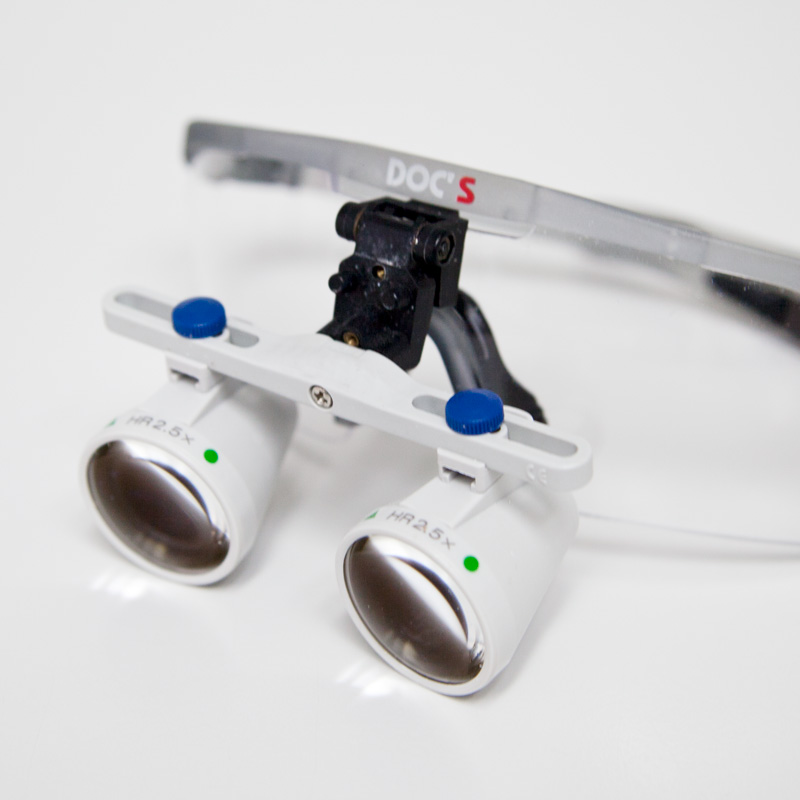
Many details on a tooth are barely visible to the naked eye – fine cracks in the enamel, the margin of a filling, caries beginning in a fissure. Magnifying loupes enlarge the working field several times over and reveal such places before they become a problem.
Together with an attached light they provide consistently good visibility as far back as the posterior teeth. That benefits more than accuracy: because the practitioner sits more upright, the work is calmer and more focused – and the treatment correspondingly gentler.
Precision
You can only treat what you can actually see. Seeing well is a basic requirement for recording findings accurately and for particularly fine, detailed work. Magnifying loupes help to recognise relevant details in the operating or treatment area.
Without dental high technology such as loupes, the higher demands patients and dentists place on precision, ergonomics and quality in modern dentistry can no longer be met.
Fine tissue structures and the smallest changes to teeth and gums are often not sufficiently visible to the naked eye. Loupes are used with the magnification appropriate to the indication. They allow a minimally invasive, tissue-preserving approach, because the smallest details can be examined exactly, delicate areas made visible and treatment carried out precisely.
There are two technically different loupe systems:
These give magnifications of 3.0 to 5.0 times, at the cost of depth of field. Because they are relatively heavy they are mostly worn as headband loupes.
Built on the Galilean system, these are very light and offer good depth of field, but only 2.0 to 3.2 times magnification.
Answered briefly