Implant shapes, systems and types of dental implant
Most implants used today are shaped like a screw, more rarely like a cylinder.
Endosseous implants
Anchoring the implant directly in the bone is called osseointegration. In Professor Per-Ingvar Brånemark's terms it means the direct functional and structural bond between living organic bone and the surface of a healed, loaded implant. Osseointegration depends on bone tissue of sufficient dimensions and proper structure, on peri-implant soft tissue free of inflammation, and on an appropriate chewing load on the implant.
Depending on the situation in the mouth and the surgical method chosen, various implant shapes and systems are available.
Implant systems
Implants for one-stage, transgingival healing: one-piece implants are placed that project through the mucosa.
Implants for subgingival placement: two-piece implants are used here. They heal covered by the mucosa, and after healing the implant heads are exposed in a second procedure. They are extended with abutments that project through the mucosa, and the prosthetic restoration is built on those abutments.
Special implant designs for immediate and early placement.
Interim implants for temporary use, limited to the healing period.
How an implant is constructed:
The implant body (the endosseous part)
The abutment (also called the secondary part)
the connection between the implant body and the superstructure
The superstructure (implant crown or restoration)
Superstructures on implants can be fixed, such as single crowns or bridges, or designed to be conditionally removable, such as bar-supported full dentures.
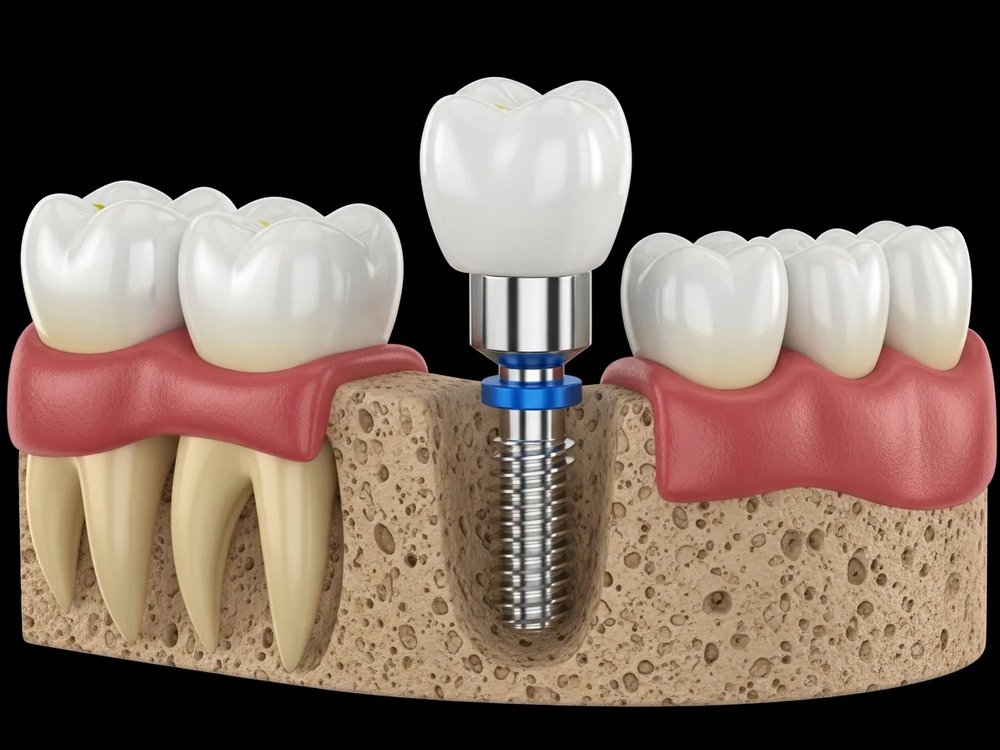
Shapes and systems
Why shape matters
Most implants used today are shaped like a screw, more rarely like a cylinder. In Germany screw-shaped types have prevailed. The shape, length and diameter of an implant vary with its intended use and the patient's clinical situation.
The biomechanical behaviour of oral implants is determined by their shape and size and by how load is distributed at the interface between the implant surface and the surrounding bone. To anchor implants over the long term and distribute forces evenly, implants have to be available in different lengths and diameters.
The standard diameters of different manufacturers vary between 3.3 mm and 5 mm, with standard lengths of 8, 10, 12, 14 and 15 mm. The type of restoration planned, the bone available and any skeletal peculiarities determine the length and diameter as well as the number, positioning and distribution of the implants. Implants of roughly 10 to 15 mm are generally enough for sufficient anchorage depth in the native bone. Where the bone is favourable in morphology and density, shorter implants can also be placed if the indication requires it. The basic rule is that the maximum possible implant length should be used.
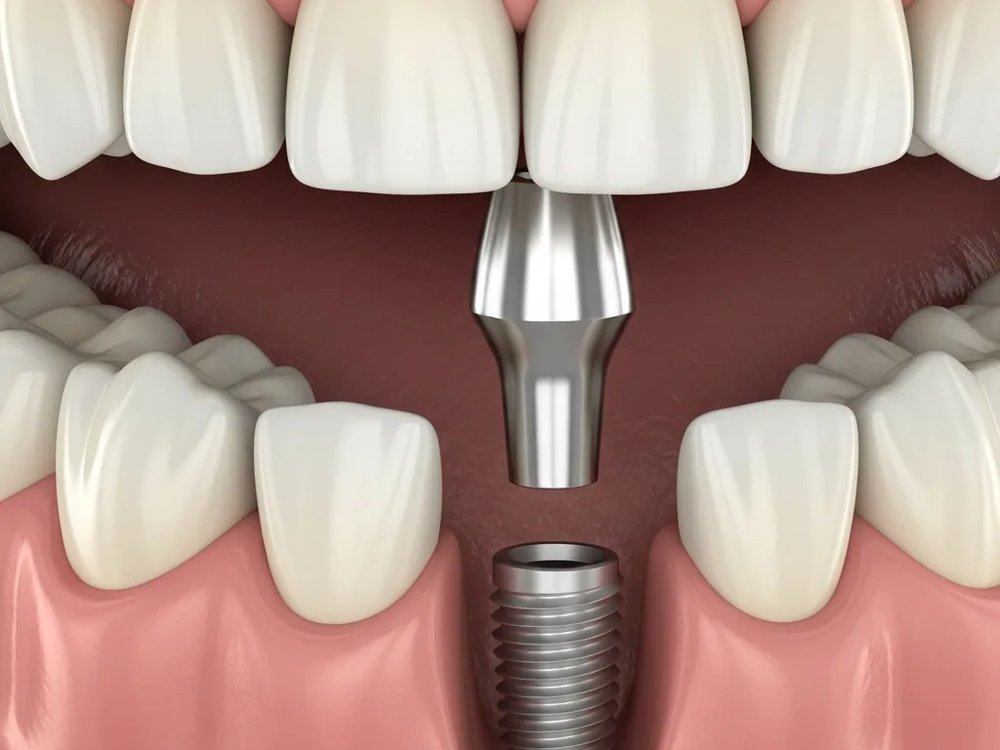
Designs
Implant shapes
Because of the favourable biomechanical properties of a screw, the following root-form implant shapes are preferred today.
Stepped implants (as screw implants)
Tapered implants (as screw implants or stepped cylinder implants)
Screw implants (with a self-tapping thread or a pre-tapped thread; good primary stability through the thread)
Now only rarely: cylinder implants (without a thread; primary stability through press fit)
The key points at a glance
- Because of their biomechanical properties, root-form screw implants are mostly used today.
- Endosseous implants are anchored directly in the jawbone by a thread and sit firmly once healed.
- In one-stage healing, one-piece implants are placed that project through the gum.
- Subgingival placement uses two-piece implants that heal covered by the mucosa and are exposed later.
Answered briefly