What do dental implants and prosthetics cost?
The price of a dental implant is made up of several separate factors.

Cost
What implant treatment costs
As a rule, people with statutory health insurance in Germany have no entitlement to dental implants. Since the beginning of 2005, however, statutory insurers have contributed fixed subsidies towards implant treatment, based on what a conventional restoration would cost.
Treatment, and the costs that go with it, differ from patient to patient. For that reason no generally valid figures can be given. Costs depend on the effort and difficulty of the surgery, on the diagnostics, on how many implants are to be placed, on the material from which the new teeth are made and on the dental technology required. Any bone-grafting measures that prove necessary also affect the cost.
Dental implants: often more economical than expected
As comparative studies have shown, conventional prosthetics are not always the most cost-efficient solution in the long run. The cost of a single-tooth restoration is said to fall below that of a conventional bridge after about seven years, because an implant-supported solution costs less to maintain over time. More important than the bare cost, though, are the better quality of life, the comfort and the sense of security that implant-supported solutions bring.
Before treatment
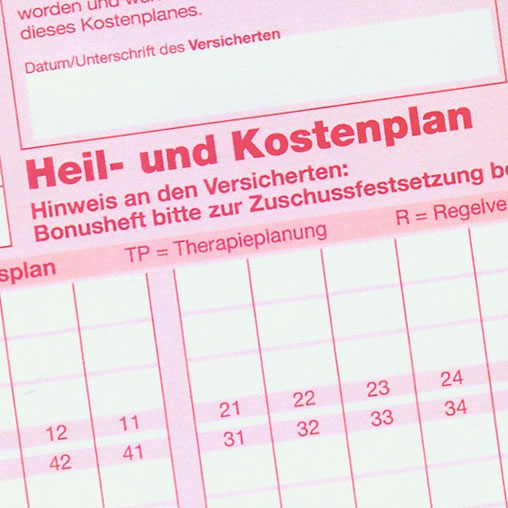
The treatment and cost plan
A treatment and cost plan sets out the solution proposed and the expenditure to be expected for it. As a rule the individual plan itemises surgery (placing the implants, bone grafting), prosthetics (fitting the teeth) and laboratory work (building the new teeth in a dental laboratory). The cost of implant work is not straightforward to compare. It is worth treating fixed or all-in prices published online, and unusually cheap treatment options, with a critical eye.
The prices given below should likewise be understood only as an average range within which implant treatment can fall. Fixed subsidies, individual insurance benefits and reimbursements are not included, as these vary with the insurer and the contract (statutory cover, supplementary dental insurance, civil-service assistance or private health insurance). The costings assume the use of branded implant systems whose results are documented by long-term scientific studies, with the prosthetic work produced in a German master laboratory.
Guide figures
Cost overview of an implant treatment
These figures are guide values from everyday practice, not binding prices. What applies in your case is set out in the treatment and cost plan drawn up by your dentist.
Diagnostics and planning
- Initial assessment (per jaw, one-off)
- approx. €150 to €350
The cost of an orthopantomogram (OPG) is covered by statutory health insurance.
Three-dimensional diagnostics
- Computed tomography (CT)
- approx. €150 to €250
Cone beam computed tomography (CBCT)
Cone beam computed tomography is not reimbursed by statutory health insurers. The technique is only recommended where, in complex or unclear situations, it helps to make implant placement easier to plan and to avoid possible risks.
- CBCT scan (image and analysis)
- €120 to €250
This covers taking the image (digital capture) and analysing it.
- Producing a surgical guide for guided implantology
- €150 to €250
Surgery
- Bone grafting with bone substitute material (for the substitute material)
- approx. €150 to €200
- with a membrane
- up to approx. €400
- Professional fee
- €100 to €300
- using the patient's own bone from the mouth
- from €100
- where a block of bone is harvested
- up to €1,000
Augmentation of the sinus floor / sinus lift
- Small (internal) sinus lift (plus bone substitute material if required, see above)
- €150 to €350
- Large (external) sinus lift (plus bone substitute material and membrane, see above)
- €350 to €1,250
- with bone harvested from the iliac crest (plus anaesthesia)
- approx. €400
Implant placement
- Placing the implant, per implant including materials
- €650 to €1,500
Consumables
- Drills and surgical consumables
- approx. €100 to €300
Prosthetics
- Cost of the implant abutment components
- approx. €100 to €400
- Laboratory costs / making the restoration (depending on material), per crown
- approx. €150 to €650
Total costs
- Single-tooth implant, front tooth
- €1,400 to €3,000
- Single-tooth implant, back tooth
- €1,250 to €2,500
- Implant-supported bridge (on two implants)
- €2,500 to €4,250
- Removable implant-supported denture on two implants with a bar attachment
- €3,500 to €5,000
- Removable implant-supported denture on four implants with a bar attachment
- €4,800 to €10,000
- Removable implant-supported denture on four implants with ball attachments or locators
- €4,800 to €7,000
- Permanently fitted restoration on implants, per jaw
- from around €10,000
Statutory health insurers pay a fixed subsidy; how much depends on the findings and on the patient's bonus record. Details are given under reimbursement.
The key points at a glance
- Statutory health insurers do not cover implants in full, but since 2005 they have paid a findings-based fixed subsidy.
- The subsidy is based on what a conventional restoration would cost.
- Costs differ from patient to patient, so no generally valid figures can be given.
- Comparative studies suggest that a single-tooth implant can work out cheaper than a bridge after about seven years.
Answered briefly